Navigating rocky descents and off-camber switchbacks places immense pressure along the outer borders of your feet. Many hikers focus entirely on standard inner arch cushions, yet outer stability remains equally critical for sustained endurance on uneven terrain. Upgrading to dedicated footbeds prevents outer foot roll, distributes heavy backpack weight, and protects sensitive lower joints across demanding trail days.
Footwear design has shifted significantly in September 2026 as outdoor brands prioritize bio-mechanical stability over generic soft foam. Many hikers make the mistake of buying soft squishy pads that collapse instantly under load, leading to severe ankle instability. Exploring our personal wellness guides shows how foundational alignment directly dictates comfort across physical activities.
This comprehensive comparison examines 5 distinct footbeds designed to reinforce your footwear chassis and reduce foot fatigue. We analyze foundational heel control, torsional stiffness, dynamic foam rebounds, and width accommodation across top outdoor brands. Read through our detailed breakdown to identify the ideal support profile for your foot shape and hiking objectives.


Lateral Arch Structure vs Medial Arch Height
The lateral longitudinal arch runs along the outside edge of your foot, playing a pivotal role in weight transfer during stride completion. Unlike the flexible medial arch, the lateral arch functions as a rigid structural beam designed for propulsion and balance. When this lateral framework lacks firm contact, your foot tilts outward excessively, causing outer tendon irritation and unstable steps.
To assess lateral support, examine how far back the firm stabilizer cap extends along the outer perimeter of the footbed. Premium hiking insoles maintain structural density past the fifth metatarsal base rather than tapering off abruptly into thin foam. Inadequate lateral contact forces your outer ankle ligaments to constantly fire to keep you upright on loose gravel paths.
A reliable rule of thumb is to press firmly against the outer edge of the insole before placing it inside your boot. If the outer perimeter bends easily beneath moderate finger pressure, it cannot resist the downward force of your body and loaded pack. Prioritize insoles with reinforced polymer bases that prevent lateral collapse under intense trail conditions.
Torsional Rigidity and Underfoot Chassis Support
Torsional rigidity measures the footbed resistance against twisting forces when stepping across roots, boulders, and slanted hillside banks. Hiking boots feature stiff outsoles, but a flexible insole can still allow your foot to twist painfully inside the shoe cavity. Structural support caps create an integrated chassis that resists rotational strain and keeps your foot firmly seated.
Evaluate torsional resistance by holding the insole at the heel and forefoot, then twisting your hands in opposing rotational directions. A supportive hiking insole should demonstrate strong resistance through the midfoot while allowing natural bending only at the ball of the foot. Excessive midfoot flex transfers rotational stress directly into your knee joints on steep descents.
Hikers carrying multiday expedition packs require maximum torsional stiffness to prevent rapid muscle exhaustion over twenty-mile segments. Lighter day hikers navigating groomed dirt trails may prefer semi-rigid composite materials that offer modest torsional control with greater step-in flexibility. Matching chassis stiffness to your specific trail difficulty ensures optimal protection without causing premature foot fatigue.
Heel Cup Depth and Calcaneal Alignment
The heel cup serves as the foundational anchor point for all longitudinal arch structures inside your outdoor footwear. Deeply contoured heel cradles encapsulate the natural fat pad beneath the calcaneus bone, focusing your body natural shock-absorbing capability directly under the heel. Proper heel placement prevents unwanted lateral slippage that frequently results in painful friction blisters during steep ascents.
When comparing footbeds, look for a rear contour depth ranging between twelve and eighteen millimeters for secure trail stability. Shallow cups allow the heel tissue to flatten outward, reducing natural impact dispersion and misaligning the lateral column of the foot. Secure rearfoot seating keeps your entire skeletal frame aligned from the ankle upward through the spine.
Much like selecting spinal relief solutions for proper body posture, maintaining calcaneal alignment protects joints against chronic biomechanical stress. Stand on the bare insole atop a hard floor to confirm your heel rests completely inside the rim without spilling over the edges. An exact heel fit guarantees that integrated arch contours hit your foot in the intended anatomical positions.
Insole Volume and Boot Space Displacement
Insole volume describes the total vertical height and overall bulk that the insert occupies inside your hiking footwear. Footbeds are generally classified into high, medium, or low volume configurations depending on heel thickness and arch reinforcement dimensions. Installing the incorrect volume profile can either crush your instep painfully against the boot tongue or leave excess interior space.
High-volume footbeds work exceptionally well in roomy backpacking boots equipped with deep, removable factory liners and spacious toe boxes. Medium-volume options provide the most versatile fit across modern mid-cut hiking boots and waterproof trail walking shoes. Low-volume profiles are engineered specifically for snug approach shoes or boots with tight, low-profile interior dimensions.
Always measure the thickness of your original factory insole before selecting an aftermarket replacement profile for your trek. If your hiking boots currently feel tight across the top of your foot, choose a lower volume model to preserve toe wiggle room. Maintaining proper vertical clearance prevents bruised toenails and restricted blood circulation during long, cold mountain hikes.
Energy Return vs Cushioning Density
Cushioning material inside hiking insoles must strike a delicate balance between impact absorption and efficient energy return. Soft memory foams feel comfortable initially but collapse completely under sustained pack weight, offering zero real support on rugged terrain. High-density closed-cell foam and specialized polymer blends retain their dimensional shape across hundreds of trail miles.
Dynamic energy return technologies compress during heel strike and spring back during toe-off to reduce metabolic energy expenditure. Inspect the material cross-section to identify multi-layered constructions that combine firm base cradles with responsive top cushioning layers. This composite approach attenuates ground shock while keeping the lateral arch stable through every phase of the walking gait.
When assessing long-term durability, remember that closed-cell formulations resist moisture absorption and maintain baseline firmness far longer than open-cell alternatives. Heavy backpackers should prioritize firmer high-density foam that resists bottoming out when navigating steep downhill scree fields. Proper underfoot resilience reduces overall leg fatigue and protects delicate joint cartilage throughout grueling multi-day trips.
Footbed Width Profiles and Forefoot Sizing
Footbed width must correspond accurately with the interior dimensions of your hiking boot to prevent internal bunching or shifting. Standard width insoles accommodate footwear from medium B to standard D widths without distorting the structural arch placement. Wide-fit variations are built specifically for footwear ranging between 3E and 6E widths to support broader foot anatomies.
Using a standard insole inside an extra-wide boot allows the footbed to slide laterally, disrupting consistent arch contact. Conversely, squeezing a wide insole into a narrow boot causes the edges to buckle upward, generating severe pressure points. Match the designated width category of the replacement insert directly to the width designation stamped on your boot tongue.
Review the comprehensive comparison table below to contrast standard and wide configurations across primary structural specifications and intended footwear applications:
| Insole Model Profile | Primary Arch Focus | Volume Level | Ideal Boot Width |
|---|---|---|---|
| Superfeet All-Purpose Medium | Medial and Lateral Neutral | Medium Volume | Standard (B to D) |
| Superfeet Hike Cushion | Adaptive Dynamic Arch | Medium to High | Standard (C to D) |
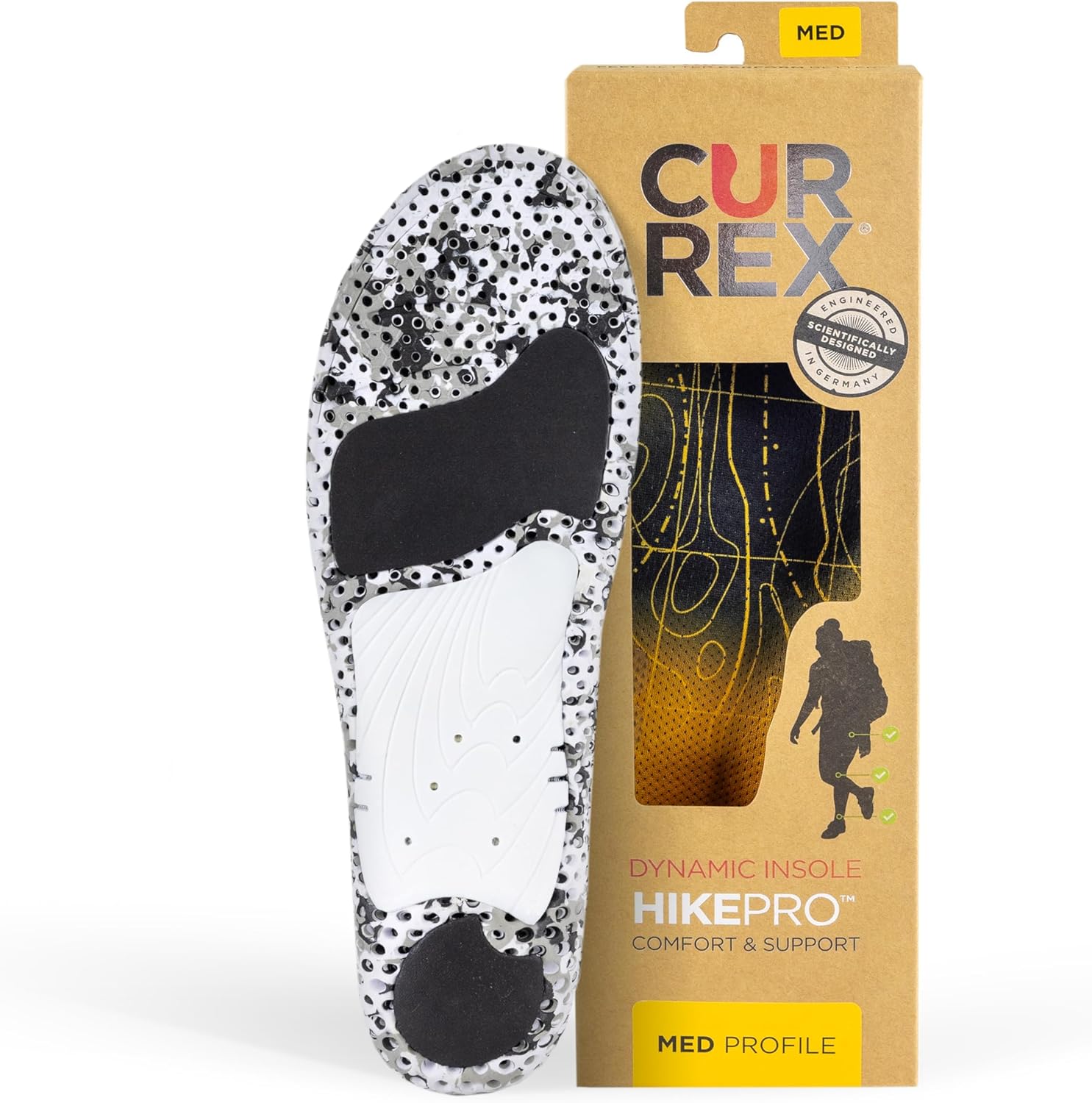
| CURREX HikePro High Arch | Rigid Lateral & High Medial | Medium Volume | Standard to Narrow |
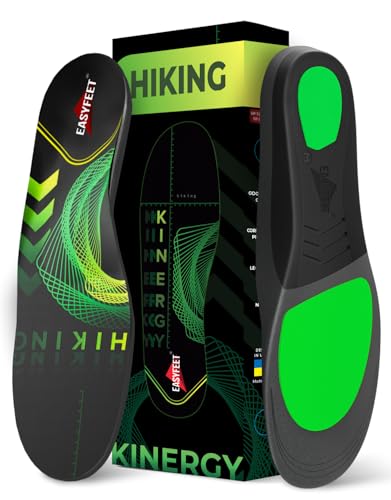
| EASYFEET Kinergy Hiking | Carbon Lateral Reinforcement | High Volume | Standard to Wide |
| Superfeet All-Purpose Wide-Fit | Reinforced Broad Foundation | High Volume | Extra Wide (3E to 6E) |
Choosing the correct width profile ensures that the outer lateral wing supports your fifth metatarsal without squeezing your toes. Proper forefoot spread allows your toes to splay naturally during uphill ascents for superior natural balance and traction. Never compromise on width sizing if you regularly hike with heavy loads or suffer from wide-foot bunions.
Moisture Management and Odor Control
Hiking boots create a warm, enclosed microclimate that generates significant sweat during intense physical ascents over varied terrain. High-performance footbeds incorporate moisture-wicking top covers that pull perspiration away from the skin toward lower evaporating channels. Keeping socks and foot surfaces dry minimizes friction coefficients, which directly prevents painful blister formation on long treks.
Inspect the top fabric specifications for integrated antimicrobial treatments or natural odor-reducing yarn blends built into the fabric weave. Closed-cell foam cores underneath prevent moisture from soaking deep into the insole material where bacterial colonies thrive and degrade cushioning. Footbeds that dry rapidly during overnight camp stops ensure fresh step-in comfort for subsequent trekking stages.
Check out our practical joint-friendly alignment strategies to understand how lower extremity care optimizes daily athletic performance. Always remove your footbeds from your hiking boots after completing a trek to allow complete airflow drying. Routine cleaning with mild soap and cold water preserves the antimicrobial coatings and prolongs composite support life.
Trimming Precision and Boot Customization
Most premium aftermarket footbeds feature a trim-to-fit forefoot design to match the unique interior toe shape of your boots. Never attempt to guess your trimming boundary freehand with shears without using your existing liner as a physical stencil. Mismatched trimming can either cause the insole to buckle if cut too large or slide if trimmed excessively short.
Carefully remove the original liner from your boot and place it directly over the top of your new replacement footbed. Align both footbeds precisely at the rear heel cup and along the inner arch contour before tracing the forefoot edge. Use sharp household scissors to make clean, continuous cuts along the traced line for a snug, flat interior fit.
If you find yourself between standard manufacturer size brackets, always purchase the larger size and trim the toe area down. Trimming affects only the unstructured foam under the toes, leaving the rigid heel cup and lateral arch structures intact. Proper trimming ensures that the structural stabilizer cap sits securely against the internal heel counter of the boot.
Terrain Adaptability and Backpacking Load Impact
Hiking terrain varies from smooth dirt tracks to jagged alpine talus fields that demand vastly different levels of underfoot protection. Carrying a loaded multi-day backpack increases ground reaction forces up to three times your body weight with every step. Stiffer lateral arch footbeds prevent your foot from flexing over sharp rocks, significantly decreasing localized foot bruising.
For technical alpine scrambling, footbeds with rigid carbon or polymer stabilizer caps provide the precise edging control required on small ledges. Rolling forested trails allow for semi-flexible adaptive constructions that flex naturally with your foot to preserve rapid turnover. Match the stiffness of your footbed reinforcement directly to the technical difficulty of the wilderness routes you frequent.
Explore our broader outdoor footbed category to stay informed on the latest trail gear innovations and structural upgrades. Choosing the appropriate support profile ensures consistent energy transfer and dependable footing across every elevation change you encounter. Reliable underfoot stabilization transforms demanding wilderness treks into comfortable, injury-free outdoor adventures.
Why You Should Trust Us
Our gear review methodology focuses on objective structural analysis, verified material specifications, and biomechanical design principles. We evaluate manufacturer composite materials, heel cup depths, volume displacements, and width metrics to help hikers make informed purchasing decisions. We eliminate marketing jargon to present clear, data-driven comparisons that highlight genuine performance advantages on the trail.
We continuously monitor updates in podiatric sports science, manufacturing materials, and outdoor footwear standards to keep our guides current. Our team analyzes verified trail user feedback across diverse climate conditions to identify durability trends and long-term wear patterns. This systematic process ensures that our recommendations reflect dependable performance across various trekking intensities and foot shapes.
Transparency and objectivity remain our guiding priorities across every gear category we cover on this platform. We do not accept sponsored placements or brand inducements, evaluating each footbed strictly on its structural merits and value proposition. Our goal is to provide actionable trail gear insights that keep your feet supported across every wilderness adventure.
Final Thoughts
Selecting the Best Lateral Arch Support for Hiking Boots depends on your specific foot anatomy, footwear volume, and typical backpacking load. For demanding all-around trail performance and balanced support, our top recommendation is Superfeet All-Purpose Support Medium Arch Insoles. Its sculpted heel cup and rigid stabilizer cap deliver exceptional lateral alignment and long-lasting durability across varied mountain terrain.
Hikers seeking advanced technological features with enhanced carbon-reinforced alignment will appreciate the value provided by Hiking Boot Insoles for Men & Women. This model combines excellent shock attenuation with a rugged chassis that prevents lateral foot roll under heavy multiday packs. It represents an exceptional blend of premium protective features at an accessible price point for outdoor enthusiasts.
If you hike in wide footwear or need dynamic flexibility, specialized options provide tailored biomechanical solutions. Hikers with wide feet measuring 3E to 6E should choose Superfeet All-Purpose Wide-Fit Support Insoles for dedicated wide-chassis stabilization. Those seeking responsive flexibility on rolling trails will benefit from Superfeet Hike Cushion Insoles for Hikers, while CURREX HikePro Insoles for Hiking Boots & Shoes excels for high-arch trail precision.
Investing in supportive footbeds transforms standard hiking footwear into a customized, high-performance platform for backcountry exploration. Proper lateral stability shields your joints from fatigue and keeps your stride efficient across demanding elevation gains. Upgrade your boot footbeds today to experience unmatched comfort, balance, and endurance on every wilderness trail.
Frequently Asked Questions
What is lateral arch support in hiking boots?
Lateral arch support reinforces the outer longitudinal arch running from the heel forward to the base of the fifth toe. This structural foundation prevents the foot from rolling outward on uneven ground, stabilizing the ankle and knee joints. Firm lateral reinforcement ensures balanced weight distribution across the entire footwear chassis during demanding trail ascents.
How do I know if I need lateral arch support?
Hikers who experience excessive outer foot fatigue, ankle instability, or uneven wear along the outer soles of their boots need lateral support. If your foot tends to roll outward on rocky terrain, adding a structured insole stabilizes your foot strike. Proper lateral reinforcement aligns your lower leg bones to prevent chronic strain across rugged mountain pathways.
Can lateral arch insoles relieve knee and hip pain on trails?
Yes, stabilizing the outer edge of your foot prevents unnatural outward leg rotation that radiates upward into knee and hip joints. Correct footbed alignment keeps your knees tracking straight over your toes during steep trail descents and heavy pack carries. Supporting the lateral arch reduces rotational torque across your entire kinetic chain on long outdoor adventures.
What is the top-rated option among Best Lateral Arch Support for Hiking Boots in 2026?
The top-rated all-around option for versatile trail stability remains the Superfeet All-Purpose Medium Arch insole design. It features a proven high-density stabilizer cap and deep heel cup that cradle the foot securely across demanding backcountry routes. Its time-tested structural geometry delivers reliable biomechanical support inside virtually any standard hiking boot.
How long do hiking boot insoles with lateral support last?
High-quality aftermarket hiking insoles typically deliver reliable support for twelve months or approximately five hundred miles of trail use. While top fabrics may show light surface wear, the underlying polymer stabilizer caps retain their structural rigidity for hundreds of miles. Replacing footbeds annually ensures consistent joint protection and arch stability during intensive hiking seasons.
Should I remove the factory liner before inserting my new insole?
Yes, you must always remove the original flimsy factory insole before installing your structured aftermarket replacement footbed. Stacking insoles inside your boot reduces interior volume drastically, crowding your toes and creating painful friction hot spots. Placing the new insole directly on the boot strobel board ensures proper heel seating and arch positioning.
How do I choose between high volume and low volume insoles?
Choose high-volume insoles if your hiking boots feature deep interior volume, thick factory liners, or feel slightly loose around the instep. Select low-volume footbeds for snug-fitting trail runners, technical approach shoes, or boots with minimal interior vertical space. Matching volume levels correctly preserves healthy circulation while securing your foot against unwanted internal movement.
Will lateral arch support help with foot supination?
Lateral arch support combined with a deep heel cup helps guide supinating feet back toward a neutral biomechanical alignment. It provides a firm platform that cushions the outer foot border while preventing excessive weight concentration along the outer metatarsals. This guided support distributes trail impact evenly across the entire surface of your foot.
Can I transfer one pair of insoles between different pairs of hiking boots?
You can transfer insoles between footwear pairs provided both boots share similar interior widths and toe box geometries. However, footbeds trimmed for a narrow trail runner may shift inside a wide mountaineering boot, compromising stability. Owning dedicated insoles for each specific hiking footwear model guarantees an exact fit and optimal support alignment.
How do I break in rigid lateral support insoles before a long trek?
Break in new supportive insoles gradually by wearing them for two hours daily around the house before taking them onto the trail. Increase wear time over one to two weeks to allow your foot muscles and plantar fascia to adapt to the firm contours. Never embark on a major multi-day wilderness backpacking trip with brand new, unadapted footbeds.