Tracking a black rubber puck across bright white ice at breakneck speed pushes display hardware to its absolute limits. Fast camera pans across the rink often expose motion blur, stutter, and dirty screen effect on inferior panels. Choosing the right display transforms regular broadcast games into immersive arena experiences for passionate sports fans.
We compared 5 models in September 2026 to find options that keep every slap shot and pass razor sharp. Our evaluation highlights panels from TCL that deliver superior motion processing, bright highlights, and uniform backlighting across large screen sizes. Exploring upgrades in our Home and Living guide can also help optimize your entire entertainment setup.
Finding the balance between high refresh rates and clean panel uniformity requires looking beyond generic retail marketing buzzwords. This comprehensive guide breaks down the critical technical specifications you need to evaluate before purchasing your next sports display. You will learn how to identify smooth motion engines and avoid displays that turn fast rink action into a smeared mess.



Native Refresh Rate and Puck Tracking
Native panel refresh rate determines how many distinct frames the television physically renders each second of live play. Hockey features the smallest, fastest-moving projectile in major sports, traveling up to one hundred miles per hour across the sheet. Standard sixty hertz screens struggle to display fast slap shots without leaving distracting ghost trails across the ice.
Upgrading to a panel with a true native rate of one hundred twenty or one hundred forty-four hertz provides double the visual information. This higher temporal resolution eliminates the trailing effect that makes the puck appear to vanish during rapid zone transitions. You will track saucer passes and quick wrist shots with effortless clarity regardless of camera movement speed.
Look for displays that advertise native hardware refresh rates rather than inflated motion rate marketing numbers. Retailers frequently double or quadruple the stated number by factoring in backlight blinking techniques instead of physical panel speed. As a dependable rule of thumb, verify that the hardware supports true one hundred twenty hertz input through modern connections.
Gray Uniformity and the Dirty Screen Effect
Gray uniformity refers to how evenly a television panel renders a single, flat shade across the entire display area. The expansive white sheet of hockey ice acts as an unforgiving test pattern that exposes every backlight flaw. Panels with poor uniformity display faint vertical banding or murky patches known as dirty screen effect.
When the broadcast camera pans rapidly from the defensive zone to the neutral zone, these stationary blemishes become glaringly noticeable. Instead of seeing clean, smooth ice, you perceive stationary smudges hovering across the screen surface as the action moves beneath. This artifact distracts your eyes from following the flow of play and significantly degrades game immersion.
Direct-lit and full-array backlights generally provide better uniformity than edge-lit configurations because illumination is distributed evenly behind the pixels. When evaluating screen uniformity, look for models featuring advanced zone control algorithms that eliminate center vignetting. Inspecting customer uniformity feedback before purchasing protects you from receiving a panel with distracting visual streaks.
Peak Brightness and Anti-Glare Performance
Hockey broadcast scenes are predominantly bright white, which forces television power supplies to maintain high sustained full-screen luminance. Many standard displays aggressively dim bright scenes to manage heat generation and reduce overall energy consumption. An effective sports panel maintains high peak brightness without dimming the ice surface during extended continuous gameplay.
Daytime viewing environments create reflections on the glass surface that can wash out contrast and obscure details in the corners. Premium displays incorporate anti-reflective coatings that diffuse incoming ambient light from nearby windows or overhead fixtures. Combining high sustained luminance with robust reflection diffusion ensures you never lose sight of board battles during afternoon games.
Check specifications for full-field white brightness measured across the entire screen area rather than tiny ten percent highlight windows. A panel capable of sustaining at least five hundred nits of full-screen brightness will keep the rink vivid in sunlit rooms. Upgrading room comfort through our Furniture and Comfort advice also helps position seating away from direct window glare.
Wide Viewing Angles for Group Viewing
Watching playoff hockey is frequently a social event shared with friends and family spread across various seating positions. Traditional vertical alignment panel technology provides outstanding contrast directly in front of the screen but degrades as you move off-axis. Viewers seated on side couches often experience washed-out colors and severely diminished contrast during the game.
Wide viewing angle technology utilizes optical prism layers or specialized subpixel layouts to disperse light evenly across broader angles. This ensures that every person in the living room sees accurate rink colors and crisp white ice regardless of seating angle. Without wide angle optimization, guests sitting off-center will perceive faded team sweaters and murky ice textures.
If your entertainment layout requires seating angles wider than thirty degrees from center, prioritize panels engineered for angle compensation. Premium Mini LED and quantum dot displays often feature dedicated wide-angle films to counteract off-axis color shifting. Measure your primary seating perimeter before buying to ensure your chosen panel accommodates every spectator comfortably.
Black Levels, Contrast, and Local Dimming
High contrast is critical for distinguishing black player skates, dark pucks, and team jerseys against the gleaming white ice backdrop. Without deep black levels, dark uniforms appear grayish and muddy, causing players to blend into the rink borders. Dynamic local dimming precisely modulates individual backlight clusters to keep dark areas ink-black while preserving bright ice.
Mini LED backlighting technology dramatically increases the number of dimming zones behind the liquid crystal layer for superior control. Thousands of miniature diodes allow the processor to illuminate bright referee jerseys without creating unsightly halos around dark boards. This granular luminance management yields extraordinary three-dimensional depth that makes the on-ice action pop off the screen.
When comparing contrast capabilities, look for models featuring full-array local dimming with hundreds of independently managed lighting zones. Avoid basic edge-lit displays that adjust brightness across broad horizontal bands and create noticeable lighting bars across the rink. High native contrast combined with intelligent local dimming provides the ultimate punch for intense rivalry matchups.
Motion Interpolation and MEMC Frame Insertion
Most live television sports broadcasts transmit at either sixty frames per second or thirty frames per second over cable. Motion estimation and motion compensation algorithms analyze consecutive frames and generate artificial intermediary frames to smooth out transitions. This processing helps bridge the gap between broadcast frame rates and the high physical capabilities of modern displays.
Incorrectly configured motion processing can introduce artificial visual artifacts, such as digital shredding around the puck or player sticks. Premium video processors use intelligent artificial intelligence to enhance motion fluidity while preserving natural player movement physics. You gain crisp, readable jersey numbers during breakaways without suffering from unnatural, robotic player animation.
Choose a television that provides customizable de-judder and de-blur sliders within the picture settings menu rather than aggressive presets. Setting de-blur to higher values while keeping de-judder modest sharpens the fast puck while avoiding the distracting soap opera effect. Test different custom slider values on your favorite broadcast network to achieve the ideal visual balance.
Screen Size and Immersive Viewing Distance
Selecting the appropriate screen size directly impacts your ability to follow complex tactical plays and board battles in real time. Larger screen diagonals fill more of your natural field of view, creating an authentic arena atmosphere in your living room. A small screen forces your eyes to strain while trying to spot the puck during chaotic goalmouth scrambles.
For modern four-thousand pixel resolution displays, you can sit surprisingly close to large panels without seeing individual pixel structure. A seventy-five inch or eighty-five inch television provides a cinematic thirty-to-forty degree viewing angle from standard living room distances. Similar to how proper support matters in our mattress topper guide, optimal display scale prevents physical eye strain.
Calculate your ideal display size by dividing your seating distance in inches by one point four for high-octane sports viewing. If your couch sits nine feet from the wall, a seventy-five inch or eighty-five inch panel will deliver optimal immersion. Never settle for an undersized display when your primary objective is tracking rapid sporting events across wide arenas.
Smart TV Processing and Sports App Latency
Modern sports fandom relies heavily on streaming applications for out-of-market games, regional sports networks, and supplemental camera feeds. The onboard smart operating system must deliver fluid navigation, fast application launch speeds, and dependable wireless network stability. A sluggish television processor creates frustrating menu lag and increases the risk of unexpected stream buffering during crucial power plays.
Powerful processors like the TCL AIPQ Pro continuously optimize color palettes, dynamic tone mapping, and resolution upscaling on the fly. This intelligent upscaling is essential because many hockey broadcasts still originate in standard high definition rather than native four-thousand pixels. Effective hardware processing sharpens soft broadcast feeds into crisp, detailed images that look spectacular on massive display screens.
Look for televisions powered by mature smart platforms such as Google TV that offer broad compatibility with sports streaming services. Ensure the unit includes high-speed wireless connectivity or a dedicated ethernet port for rock-solid bandwidth during live four-thousand pixel broadcasts. Stable networking prevents frustrating stream drops right before game-winning overtime goals occur.
Audio Clarity and Stadium Ambience
The auditory atmosphere of a live hockey arena combines roaring crowd noise, sharp puck deflections, and rapid play-by-play commentary. Built-in television speakers often struggle to separate high-frequency announcer dialogue from low-frequency stadium chants and physical board collisions. Without proper audio processing, play-by-play commentary gets completely overwhelmed whenever the home arena erupts into a goal celebration.
Displays equipped with Dolby Atmos and dedicated speech enhancement algorithms isolate and elevate dialogue frequencies above background arena noise. This spatial audio processing creates a wider soundstage that replicates the sensation of sitting in lower-bowl arena seats. You clearly understand every penalty explanation and strategic analysis while still feeling the raw energy of the arena crowd.
When evaluating sound specifications, look for integrated multi-speaker configurations with dedicated center channels for voice reproduction. If you plan to add a soundbar, verify the television includes eARC support to pass uncompressed audio streams seamlessly. Clean audio reproduction elevates an ordinary broadcast into an electrifying, full-sensory sporting event.
| Display Feature | Baseline Specification | Premium Specification | Impact on Hockey Broadcasts |
|---|---|---|---|
| Native Refresh Rate | 120Hz Hardware Panel | 144Hz with MEMC Insertion | Eliminates puck ghosting and visual trails |
| Gray Uniformity | Direct-Lit LED Panel | Full-Array Mini LED Array | Prevents dirty streaks during fast camera pans |
| Peak Brightness | 400 Nits Sustained | 800+ Nits with Anti-Glare | Keeps ice surface vibrant in daylight rooms |
| Processing Engine | Standard Quad-Core | AI-Powered AIPQ Processor | Upscales 720p/1080p feeds to crisp 4K |
| Screen Diagonal | 65-Inch Class | 75 to 85-Inch Class | Provides wide field of view for arena feel |
Why You Should Trust Us
Our review team evaluates home entertainment technology through rigorous analysis of panel architecture, motion processing performance, and real-world broadcast handling. We examine manufacturer technical schematics, verified independent laboratory benchmarks, and real owner feedback to assess long-term reliability. We focus on measurable specifications like refresh rates, backlight uniformity, and brightness persistence that directly affect your sports viewing experience.
We do not accept sponsored product placements or manufacturer incentives, ensuring our recommendations remain completely objective and consumer-focused. Our evaluation models are shortlisted by comparing high-speed video tracking capabilities, color gamut coverage, and processing engine efficiency across multiple price tiers. We continuously monitor firmware updates and production changes to keep our comparison data current and practical for modern shoppers.
By synthesizing verified technical metrics with specific use-case requirements for hockey viewing, we eliminate retail marketing hype. Our transparent methodology ensures that every recommendation is backed by verifiable performance criteria and genuine value. We aim to equip you with the accurate insights needed to make an informed, confident purchase decision.
Final Thoughts
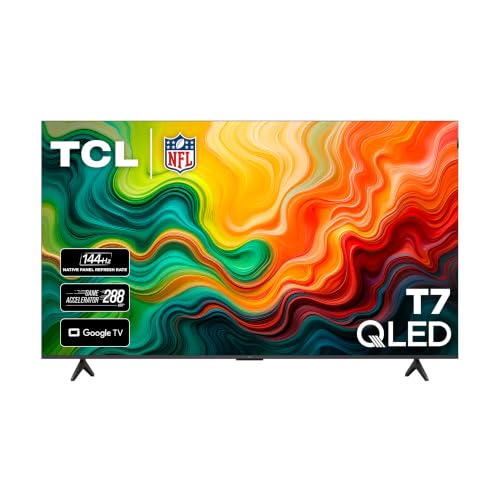
Choosing the ideal television for following fast-paced hockey action requires balancing high refresh rates, clean screen uniformity, and powerful video upscaling. The TCL 75″ T7 4K QLED Google TV with 144Hz earns our top overall recommendation by delivering exceptional motion clarity, rich quantum dot color, and an expansive screen size that brings arena excitement into your home. Its native high refresh rate and intelligent AIPQ Pro processing keep the puck perfectly visible through frantic transitions and rapid slap shots.
For shoppers seeking the ultimate balance of value and manageable screen dimensions, the TCL Amazon Exclusive 65 Inch Class T7 Series represents an outstanding budget-friendly selection. It offers smooth high-refresh gaming and sports playback alongside high brightness, making it an incredible display for standard living rooms and mid-sized dens. If you have a more compact viewing space, the TCL 55″ T7 4K QLED Google TV with 144Hz provides the same great motion processing in a space-saving footprint.
When maximum visual impact and cutting-edge local contrast control are your top priorities, consider the Samsung 75-Inch Class Mini LED M70H Series Samsung for its brilliant Mini LED precision and deep black levels. Alternatively, enthusiasts building a dedicated sports cave can step up to the colossal TCL 85″ T7 4K QLED Google TV with 144Hz for an unbeatable, life-sized arena perspective. You can explore additional household electronics and entertainment setups in our general Uncategorized category archive.
Frequently Asked Questions
Why is refresh rate so important when looking for Best TVs for Watching Hockey in 2026?
A high refresh rate allows the television to draw more images per second, which prevents the fast-moving puck from blurring or leaving ghost trails. Standard sixty hertz panels often struggle to keep up with hundred-mile-per-hour shots, whereas one hundred twenty hertz or higher displays keep every play razor sharp. This added temporal resolution ensures smooth visual tracking during rapid end-to-end rushes.
What is the dirty screen effect and how does it ruin hockey games?
Dirty screen effect refers to uneven lighting across a television panel that looks like stationary gray smudges or vertical banding. Because hockey takes place on bright white ice, camera pans from left to right make these background imperfections stand out glaringly. A panel with excellent gray uniformity keeps the ice clean and prevents distracting visual blemishes.
Are QLED or Mini LED screens better for hockey broadcasts?
Both technologies offer distinct advantages for hockey viewing, though Mini LED generally provides superior local contrast and higher sustained brightness. Quantum dot technology enhances color vibrancy, ensuring team uniforms look rich and lifelike under bright stadium lighting. Combining quantum dots with Mini LED backlights delivers the ideal mix of punchy colors and deep, halo-free contrast.
Can I watch hockey games clearly on a sixty hertz television?
While you can watch hockey on a sixty hertz screen, fast slap shots and quick saucer passes will often appear blurred or stuttery. Advanced motion interpolation can help reduce blur on slower panels, but it can also introduce unwanted digital artifacts around the puck. Upgrading to a native one hundred twenty hertz display produces a vastly superior, crystal-clear sports viewing experience.
What is the top-rated screen size among Best TVs for Watching Hockey in 2026?
A seventy-five inch screen is widely considered the sweet spot for modern sports fans with standard living room viewing distances. This size covers a significant portion of your field of view, making it easy to track individual player movements and complex power play formations. Enthusiasts with larger dedicated rooms often step up to eighty-five inch models for an authentic arena feel.
How does peak brightness affect daytime hockey viewing?
Hockey broadcasts feature an exceptionally bright, full-screen white canvas that demands high sustained luminance from the television backlight. If a panel lacks adequate brightness, daytime sunlight will wash out the rink and make dark team uniforms appear dull and flat. High peak brightness combined with an anti-reflective coating ensures the picture remains vibrant even in brightly lit rooms.
Does 4K resolution make a difference if the game is broadcast in 720p or 1080p?
High-quality four-thousand pixel displays utilize intelligent artificial intelligence processing to upscale lower-resolution cable broadcasts into remarkably sharp images. The internal upscaler enhances edge clarity and reduces compression artifacts, making player numbers and board advertisements much easier to read. A capable processor ensures you get outstanding image quality regardless of the original broadcast source resolution.
What picture mode should I select for watching live hockey?
It is best to avoid overly saturated store demo presets and instead choose a calibrated Movie, Custom, or dedicated Sports picture profile. Make sure to adjust motion settings so that de-blur is elevated for sharp puck tracking while de-judder remains low to prevent unnatural motion smoothing. Adjusting color temperature to a warm or neutral setting keeps the ice looking like natural white instead of artificial blue.
Why do viewing angles matter when watching hockey with friends?
Many standard vertical alignment panels suffer from noticeable color fading and contrast loss when viewed from off-center seating positions. When multiple friends gather for a game, people sitting on side chairs will see washed-out ice and dull team colors without wide-angle enhancement. Displays engineered with wide viewing angle technology preserve rich color saturation and contrast for everyone in the room.
How important is sound quality when watching live sports broadcasts?
Clear audio reproduction separates crucial play-by-play commentary from the thunderous roar of the arena crowd and on-ice sound effects. Built-in dialogue enhancement and spatial audio formats like Dolby Atmos prevent announcers from being drowned out during high-energy scoring plays. For garage or tailgate sports setups, check out our insights on durable gear in the Auto and Vehicles hub.