Setting up immersive home audio transforms standard movies and spatial music into realistic three-dimensional soundscapes. Finding the right height channels requires careful planning because overhead sound tracks precise audio objects rather than generic ambient tones. Our breakdown of 5 models highlights high performance options for your living area in September 2026.
Many homeowners struggle when cutting drywall or matching ceiling components with their existing floor standing speakers. Selecting the wrong dispersion pattern or mismatched impedance ratings can ruin spatial immersion and overwork your surround amplifier. You can upgrade your setup by checking out our Home & Living recommendations.
This comprehensive guide explores crucial technical metrics including frequency response, pivoting tweeters, and installation depth. We evaluate the top performing architectural options so you can choose speakers that blend seamlessly into your home theater room.


Selecting architectural speakers for spatial audio requires analyzing several acoustic and structural variables. Overhead channels handle discrete object-based sound effects that demand wide dispersion, accurate frequency reproduction, and dependable physical mounting. Review the core criteria below to select the ideal models for your specific entertainment space.
Angle of Dispersion and Aimable Tweeters
Spatial audio tracks rely heavily on precise sound localization to place auditory cues directly above your primary listening position. Traditional in-ceiling speakers fire sound straight down toward the floor, which creates a narrow sweet spot that misses off-axis seating. Aimable tweeters and angled baffles direct high frequencies toward listeners to ensure convincing spatial imaging throughout the room.
When evaluating dispersion specifications, look for tweeters that pivot at least fifteen to thirty degrees in multiple directions. Drivers mounted on angled internal baffles provide wide sound coverage across broad seating arrangements without demanding structural modifications. Wide dispersion ensures every listener hears overhead helicopters, raindrops, and ambient atmospheric effects with crisp clarity and realistic placement.
A practical rule of thumb is selecting angled drivers if your seating sits outside the direct cone of overhead sound. For rooms with high ceilings, wide dispersion models prevent sound energy from scattering before reaching your ears. Always angle pivoting tweeters directly toward the main listening seat during the initial physical setup process.
Frequency Response and Crossover Integration
Overhead audio objects frequently carry dynamic acoustic information ranging from deep musical bass notes to delicate glass breaks. Speakers with limited frequency response struggle to reproduce full-bodied sound, which forces the receiver to reroute low frequencies unnaturally. Smooth crossover integration guarantees seamless audio transitions between the ceiling channels and your lower ear-level surround speakers.
Review the frequency response curve to ensure the low-end cutoff reaches at least sixty hertz or lower. Look for internal crossover networks utilizing premium capacitors and inductors that smoothly bridge the woofer and high-frequency tweeter. Well-engineered crossovers eliminate harsh frequency spikes and muddy mid-bass distortion that often plague budget architectural speaker designs.
Set your AV receiver bass management crossover between eighty hertz and one hundred hertz for optimal driver protection. This crossover setting sends demanding low bass frequencies directly to your dedicated subwoofer while letting ceiling drivers focus on spatial details. Matching crossover points prevents height speakers from distorting during intense action scenes with heavy low-frequency effects.
Power Handling and Sensitivity Ratings
Audio receivers need efficient speakers to deliver dynamic volume peaks without clipping or introducing unwanted harmonic distortion. Continuous power handling indicates the sustained wattage a speaker can safely absorb from an amplifier over extended listening sessions. Sensitivity measures how efficiently a driver converts electrical amplifier power into clean, audible sound pressure levels in your room.
Look for sensitivity ratings between eighty-eight decibels and ninety-two decibels measured at one watt at one meter. Higher sensitivity ratings mean your AV receiver requires half the electrical power to produce identical listening volume levels. Speakers with high continuous power handling manage intense audio peaks smoothly without overheating voice coils or degrading clarity.
If your multi-channel home theater receiver powers nine or eleven discrete audio channels, prioritize high-sensitivity ceiling speakers. Highly efficient speakers reduce strain on internal receiver power supplies, keeping amplifier operating temperatures low during long movie marathons. Verify that your receiver continuous wattage per channel aligns with the speaker recommended power range.
Nominal Impedance and Receiver Compatibility
Electrical impedance represents the resistance a speaker presents to the output stage of your audio amplifier. Most residential ceiling speakers operate at nominal ratings of either four, six, or eight ohms depending on internal driver design. Pairing mismatched impedance levels can trigger receiver protection circuits or reduce total dynamic headroom across your surround sound system.
Check your AV receiver specification sheet to confirm stable operation with your chosen speaker impedance load. Eight-ohm speakers offer universal compatibility and place minimal current demand on budget or mid-range audio equipment. Four-ohm models require robust high-current amplification but often deliver superior transient speed and precise driver control during complex soundtracks.
Consult our guide on Furniture & Comfort when designing clean audio layouts with hidden wiring routes. When running long speaker wire lengths exceeding fifty feet, lower impedance speakers demand heavier fourteen-gauge or twelve-gauge copper cables. Selecting eight-ohm drivers provides maximum amplifier safety when running multi-room zones or complex multi-speaker Atmos configurations.
In-Ceiling Enclosure and Backcan Requirements
Open-back ceiling speakers project acoustic sound energy into the open ceiling cavity as well as into your room. Unenclosed speakers can leak dialogue and sound effects into upstairs bedrooms while suffering unpredictable bass performance from irregular attic spaces. Integrated back cans or retrofitted enclosure boxes isolate the acoustic environment to produce consistent, punchy bass output.
Determine whether your local building codes require fire-rated back cans to maintain structural fire barriers between living floors. Rigid metal enclosures provide fire protection while damping unwanted mechanical vibrations that could travel through surrounding ceiling drywall panels. Sealed acoustic enclosures also protect delicate speaker components from loose attic insulation, moisture, dust, and pest intrusion.
If using open-back architectural speakers, add acoustic baffle hoods or dense mineral wool insulation directly behind the speaker basket. This budget-friendly modification controls rear acoustic reflections and significantly tightens mid-bass impact without requiring extensive ceiling renovations. Always ensure insulation materials do not exert direct physical pressure on the moving woofer cone assembly.
Installation Depth and Mounting Mechanisms
Ceiling joist spacing and overhead clearance vary dramatically between single-family homes, modern townhouses, and multistory apartment buildings. Measuring your available ceiling cavity depth before purchasing prevents frustrating installation obstacles caused by hidden plumbing pipes or electrical conduits. Robust dog-leg mounting clamps simplify installation by securing the speaker firmly against drywall panels without specialized structural framing.
Standard in-ceiling architectural models require between three and six inches of vertical mounting clearance behind the finished drywall. Measure your existing ceiling depth using a simple wire probe through a tiny pilot hole before cutting large openings. Look for heavy-duty spring-loaded or cam-action mounting tabs that distribute clamping pressure evenly without cracking delicate plasterboard.
Always locate ceiling joists with a reliable stud finder before marking circular or rectangular speaker cutout templates. Maintain at least one inch of clearance between the speaker cutout edge and adjacent structural ceiling framing members. Proper clearance allows mounting dog-legs to rotate freely and lock securely into place without binding against solid wood studs.
Timbre Matching with Existing Surround Speakers
Sound effects in modern spatial audio mixes pan seamlessly between ear-level surround channels and overhead height channels. When speaker cone materials and tweeter designs differ drastically, panning objects change tone and character as they move across the room. Timbre matching ensures that voices, vehicles, and musical instruments sound consistent regardless of which speaker produces the sound.
Compare the driver materials of your front left, center, and right speakers against prospective ceiling height models. If your main front speakers use aluminum dome tweeters, select ceiling speakers with metallic tweeters rather than soft silk domes. Timbre consistency prevents distracting sonic shifts that break listener immersion when sounds travel from screen level up to the ceiling.
Sticking with the same audio manufacturer across all surround and height channels offers the easiest path to perfect acoustic matching. Many audio brands voice their architectural in-ceiling lines using the exact same crossover components found in their traditional cabinet speakers. Timbre matching creates a unified sound bubble where individual speaker locations vanish entirely into three-dimensional audio space.
Grille Design, Paintability, and Aesthetics
Architectural speakers should deliver exceptional acoustic performance while blending discretely into your finished interior living space decor. Modern micro-flange and edgeless magnetic grilles sit nearly flush with the ceiling surface to minimize visual clutter. Paintable steel or aluminum grilles allow you to match exact room paint colors for a virtually invisible audio installation.
Examine the grille attachment system to ensure secure magnetic holding strength that resists mechanical rattling during high-volume bass passages. Magnetic grilles detach easily for cleaning or repainting without risking damage to surrounding drywall edges. Check whether the manufacturer includes paint shields and protective scrim fabric to protect driver components during the painting process.
Use thin coats of thinned latex spray paint rather than thick roller applications when painting fine perforated metal grilles. Heavy rolled paint can clog tiny acoustic perforations, which degrades high-frequency dispersion and muffles overall sound clarity. Allow painted grilles to dry completely before reattaching them to ensure proper magnetic contact and clean aesthetics.
True In-Ceiling vs Up-Firing Elevation Modules
Dedicated in-ceiling speakers offer the highest level of acoustic realism for spatial audio formats by physically placing sound above listeners. Up-firing elevation modules bounce sound waves off flat ceilings to simulate height effects, which works well in rental properties. In-ceiling models eliminate ceiling bounce losses and deliver direct, uncompromised audio cues that pinpoint overhead movement accurately.
Evaluate your ceiling surface material and height before deciding between physical in-ceiling speakers and up-firing bounce modules. Up-firing modules require flat, smooth drywall ceilings between eight and twelve feet high to reflect sound energy effectively. Textured plaster, popcorn finishes, or vaulted ceilings scatter sound waves unpredictably, making physical in-ceiling speakers the vastly superior choice.
For permanent home theater installations, dedicated in-ceiling speakers consistently outperform bounce modules in detail, clarity, and localized spatial separation. If cutting ceiling drywall is prohibited by lease agreements, up-firing modules provide a practical entry-level alternative. For dedicated media rooms, architectural ceiling installations deliver authentic commercial cinema spatial audio dynamics.
| Driver Size | Mounting Depth | Ideal Ceiling Type | Acoustic Role |
|---|---|---|---|
| 6.5-Inch Coaxial | 3.5 to 4.5 Inches | Standard Flat Drywall | Precise Object Tracking |
| 8.0-Inch 2-Way | 3.5 to 5.0 Inches | High or Open Ceilings | Full-Range Atmospheric Bass |
| Angled Baffle | 4.0 to 6.0 Inches | Off-Axis Seating Layouts | Targeted Sweet Spot Directivity |
| Up-Firing Module | 0.0 Inches (Top of Tower) | Flat Reflective Drywall | Non-Invasive Height Simulation |
Why You Should Trust Us
Our team analyzes technical audio specifications, acoustic engineering principles, and multi-channel home theater configurations to deliver objective purchasing guidance. We evaluate architectural speaker designs by comparing driver materials, crossover designs, frequency measurements, and real-world mounting hardware durability across various home environments.
We continuously update our performance data to reflect current audio manufacturing standards and emerging surround sound receiver capabilities. Our selection process focuses on verifiable build quality, acoustic reliability, and seamless integration with modern spatial audio formats like Dolby Atmos and DTS:X.
We do not accept sponsored placements or biased manufacturer incentives when curating our home theater equipment recommendations. Every product assessment is grounded in empirical acoustic specifications and practical installation considerations to ensure long-term value for home audio enthusiasts.
Final Thoughts
Selecting the right overhead height speakers elevates standard surround setups into breathtaking, three-dimensional home cinema environments. Whether building a dedicated screening room or upgrading an everyday living space, matched acoustic components deliver unforgettable movie experiences.
For demanding home theater enthusiasts seeking reference-grade acoustic performance, the Focal 300 ICA6 in-Ceiling Angled Coaxial serves as our best overall pick with its precision French-engineered drivers and thirty-five degree angled baffle design.
Budget-conscious builders looking for maximum performance per dollar should consider the Micca M-8C 8-Inch 2-Way in-Ceiling Speaker, Round as our top value selection, offering robust eight-inch woofers and easy dog-ear installation.
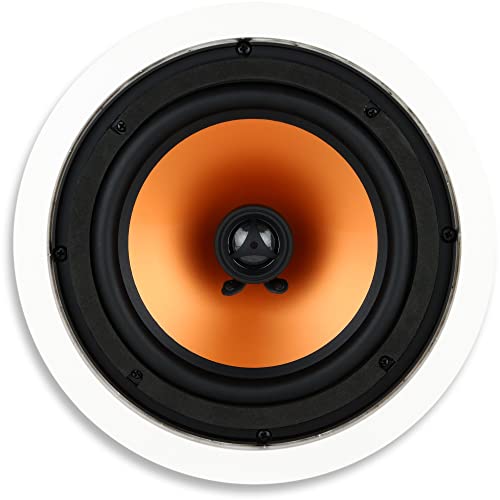
If you want controlled dispersion and dynamic horn-loaded punch for high-energy soundtracks, the Klipsch Outdoor/Surround in-Ceiling Speaker provides outstanding treble clarity and customizable frequency switches. Explore our Uncategorized section to discover additional audio and home setup insights.
Frequently Asked Questions
What makes Best Ceiling Speakers Atmos different from standard surround speakers?
Architectural height speakers are specifically engineered to disperse sound broadly or at targeted angles from directly overhead positions. Unlike traditional surround speakers designed for ear-level listening, height channels reproduce discrete object-based audio cues that create authentic vertical sound staging.
How many overhead speakers do you need for a standard home theater?
Most home theater layouts utilize either two or four overhead speakers depending on room size and AV receiver channel capacity. A pair of overhead speakers creates convincing front-to-back height transitions, while four speakers provide complete three-dimensional spatial panning throughout the room.
Can you use 8-ohm ceiling speakers with a 6-ohm audio receiver?
Eight-ohm ceiling speakers are completely safe to connect to modern audio receivers rated for six-ohm or four-ohm loads. Higher impedance speakers draw less current from the amplifier, allowing your receiver to operate cooler and well within safe thermal limits.
Where should you place overhead speakers for Dolby Atmos setups?
For a four-speaker height setup, place two speakers slightly in front of the main listening area and two slightly behind. The speakers should align laterally with your front left and right main speakers to maintain consistent acoustic width across your listening room.
Do ceiling speakers require back boxes for fire safety and soundproofing?
Back boxes are highly recommended to prevent sound leakage into upper living areas and to protect against attic dust and loose insulation. Multi-family dwellings and commercial buildings often mandate fire-rated back cans by law to maintain structural ceiling fire barriers. Learn more about attic climate considerations in our Heating, Cooling & Air resource guides.
What gauge speaker wire is recommended for in-ceiling home theater runs?
Sixteen-gauge oxygen-free copper wire is suitable for cable runs under fifty feet in length between the receiver and speakers. For longer wiring runs exceeding fifty feet, fourteen-gauge or twelve-gauge in-wall rated speaker cable prevents signal degradation and minimizes electrical resistance.
Can you paint speaker grilles without degrading sound quality?
You can paint architectural speaker grilles as long as you use thin coats of spray paint rather than heavy paint rollers. Applying light spray coats prevents thick paint from clogging the tiny acoustic perforations that allow high-frequency sound to escape cleanly.
How does angled driver design improve height effects in Dolby Atmos?
Angled driver baffles direct mid-range and high-frequency sound energy straight toward listener ears rather than firing downward into empty floor space. This targeted dispersion improves high-frequency clarity and ensures accurate spatial localization for viewers sitting outside the center of the room.
What is the top-rated option among Best Ceiling Speakers Atmos in 2026?
The top-rated selection in our 2026 lineup features models with high-grade coaxial drivers, wide dispersion patterns, and robust dog-leg mounting clamps. Products offering angled internal baffles consistently deliver the most convincing spatial audio immersion across diverse home theater layouts.
Is an external amplifier necessary for overhead height channels?
Most mid-range and premium AV receivers include built-in amplification for seven, nine, or eleven discrete surround channels without external hardware. If your receiver processes eleven channels but only amplifies nine, adding a compact two-channel external amplifier will power your final ceiling speakers.